
Table of Contents
- Why Custom Printed Tees Work for Events
- Event T-Shirt Design Ideas That Stand Out
- Bulk Custom T-Shirts: What You Need to Know
- Custom T-Shirt Printing Cost Breakdown
- Event T-Shirt Printing Turnaround Time: Planning Your Timeline
- Choosing the Right Printing Method for Your Event
- Planning Your Event Apparel Order: Step by Step
- Event Types That Benefit Most from Custom Tees
- Frequently Asked Questions
Last Updated: October 6, 2026
Why Custom Printed Tees Work for Events
Custom printed tees for events build team unity, create memorable experiences, and establish brand presence.
The global custom T-shirt printing market was valued at USD 5.2 billion in 2024 and is projected to grow significantly, according to Grand View Research's Custom T-shirt Printing Market Size Report.
At Merrickas Supply Co., bold, full-coverage prints on heavyweight fabric last through dozens of washes, keeping your event message visible long after the day ends.
Event T-Shirt Design Ideas That Stand Out
A design that looks good on a screen can fail on a shirt. The best event tees account for how the shirt will be worn, who will wear it, and the event environment.
Readability and Contrast
Event tees are often seen from a distance, in motion, or in low light, so high contrast is non-negotiable.
For event names or key text, aim for at least 3-4 inches of height. Thin, decorative fonts and script lettering break down in screen printing; sans-serif and bold serif fonts hold up better.
Inclusive Sizing and Fit
Ordering a single unisex fit excludes part of your audience. Many organizers now offer at least two fits: standard unisex and a fitted or women's cut, with youth sizes for family-oriented gatherings.
Survey registrants during sign-up if possible; otherwise use a baseline for a general adult audience: 10% XS, 15% S, 30% M, 30% L, 10% XL, 5% XXL. Outdoor and athletic events often shift 5-10% toward larger sizes.
Sponsor Placement and Branding Hierarchy
For charity runs, festivals, and corporate events, the shirt serves multiple masters: the event brand, sponsors, and participants.
With many sponsors, use a tiered approach: larger logos for top-tier sponsors, smaller for others, arranged in a clean grid or row.
Event-Specific Design Considerations
Different events impose different constraints.
For corporate events, subtlety often wins: a small left-chest logo or clean typographic front design is more likely to be worn again than a full-coverage print with a company slogan. For concerts and festivals, bold full-coverage prints are the norm.
Personalization That Adds Value
Adding individual names, team numbers, or custom elements increases perceived value, especially for sports teams, corporate team-building events, and family reunions. The trade-off is cost and production time: personalization usually requires hybrid printing or DTG, adding per-shirt charges and extending turnaround. If budget or timeline is tight, personalize only one element, like a name on the sleeve or a number on the back.
Bulk Custom T-Shirts: What You Need to Know
Ordering in bulk reduces per-unit costs significantly, but volume commitments require careful planning to avoid overbuying or underestimating your needs.
Minimum Order Quantities and Small Orders
Many custom printing providers require minimum orders of 12-24 shirts, though some accommodate smaller quantities. For a small team event or a design test before scaling up, look for providers that support low minimums without prohibitive per-shirt markups.
Bulk ordering becomes economical at 50+ shirts, where per-unit pricing typically drops 20-30% versus 12-24 pieces. For events expecting 100+ attendees, bulk pricing creates substantial savings.
Custom T-Shirt Printing Cost Breakdown
Pricing for custom t-shirt printing cost depends on quantity, print method, design complexity, and fabric quality.
Factors That Affect Your Total Price
Volume is the primary cost driver.
Print method affects pricing substantially. Screen printing works best for bulk orders with simple color designs.
Fabric weight and quality matter too. Heavyweight cotton (6+ ounces) costs more than standard weight (4.5-5.5 ounces) but delivers superior durability and print longevity.
Design complexity and setup fees can add $50-200 to your total cost.
For current pricing on custom tees, visit Merrickas Supply Co. directly.
Event T-Shirt Printing Turnaround Time: Planning Your Timeline
Turnaround time determines whether you can get your event t-shirt printing turnaround time sorted before your date. Most providers offer standard production (7-14 business days), expedited (3-5 business days), and rush services (1-2 business days).
Same-Day and Quick Production Options
Same-day printing exists but comes with steep premiums and limited customization, requiring simple designs, standard sizes, and 40-60% above normal pricing.
Quick production (2-3 business days) offers a middle ground: reasonable pricing without astronomical rush fees, and works well for events planned 2-3 weeks out.
How Far in Advance to Order
Standard production requires 4-6 weeks' advance notice, giving you buffer for design revisions, proofing, and production issues.
Three weeks out, expedited production is still feasible at reasonable costs. Two weeks or less, rush fees become significant.
Merrickas Supply Co. delivers within 2-5 business days on standard orders, so you have flexibility even with tighter timelines. Our made-to-order approach means fresh prints, not warehouse inventory.
Choosing the Right Printing Method for Your Event
Most organizers default to whatever method their printer recommends, but the right choice depends on four variables: order quantity, artwork complexity, desired hand-feel, and how long the shirt needs to last.
Screen Printing
Screen printing pushes ink through a mesh screen onto fabric. Each color needs its own screen, so setup costs are higher, but per-unit costs drop sharply at volume. For 50+ shirts with simple designs (1-4 colors), it delivers the best combination of vibrancy, durability, and cost per shirt, with prints that withstand 50+ washes when properly cured.
Direct-to-Garment (DTG)
DTG printing works like an inkjet printer for fabric. With no screens or setup fees, it's economical for small batches and one-off designs, handling unlimited colors, photographic images, and fine gradients. Trade-offs: per-unit cost is higher than screen printing at volume, colors can appear muted on dark fabrics without a white underbase, and durability isn't equal to screen printing over extreme wash cycles.
Heat Transfer (Vinyl and Digital)
Heat transfer covers two types: cut vinyl (single-color) and digital transfers (full-color). Vinyl is fast and inexpensive for simple text or logos but sits on top of the fabric and feels stiff. Digital transfers handle complex art and small quantities well. Both can crack or peel after 20-30 washes, especially with high-heat drying. Heat transfer suits last-minute orders or very small runs, but not merchandise meant to be worn repeatedly.
Hybrid and Specialty Methods
Some printers combine methods: screen printing for the base design plus DTG for personalized names or numbers. This hybrid approach is common for sports teams and corporate events needing individual customization. Specialty options like discharge printing and puff printing usually require higher minimums and longer lead times.
A Simple Decision Framework
- Under 50 shirts, complex art: DTG or digital transfer.
- 50-200 shirts, 1-4 colors: Screen printing.
- 200+ shirts, simple design: Screen printing, almost always.
- Need it in under a week: Heat transfer or rush DTG, with the understanding that durability may be lower.
- Personalized names/numbers on every shirt: Hybrid screen print + DTG, or DTG-only for small runs.
At Merrickas Supply Co., we primarily use screen printing on heavyweight fabric for event tees because it delivers the durability and bold coverage our customers expect.
Planning Your Event Apparel Order: Step by Step
Ordering custom apparel doesn't require guesswork. A structured process prevents costly mistakes.
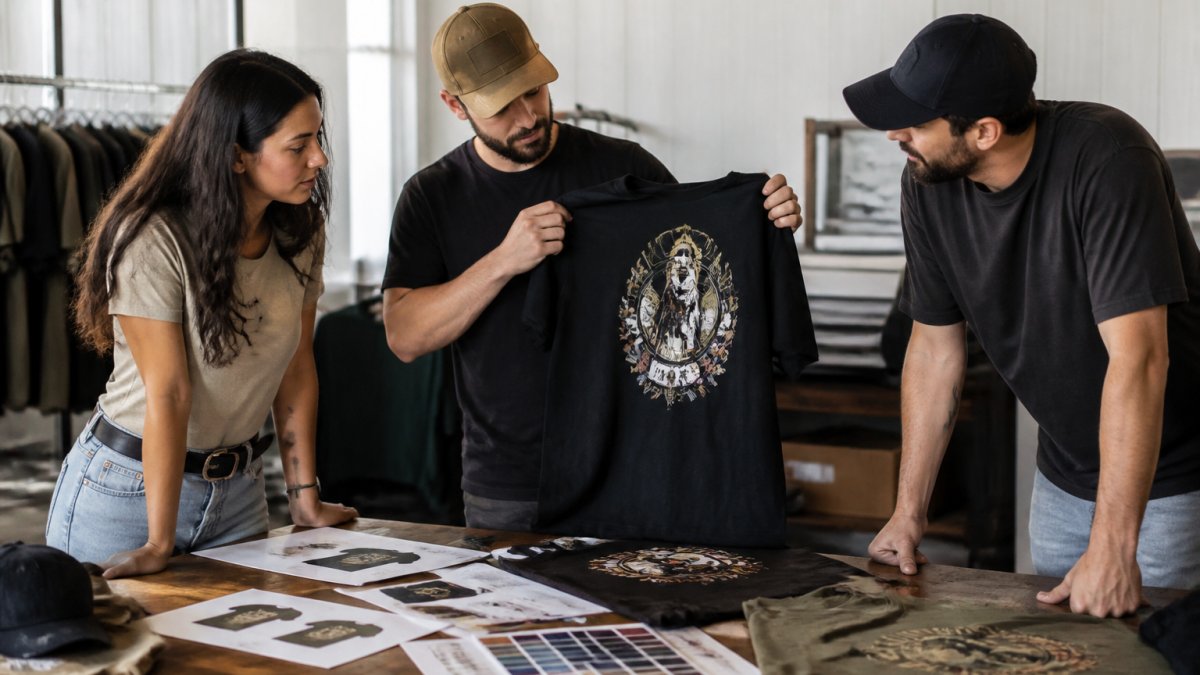
Step 1: Define Your Event and Audience
Start by clarifying your event type, expected attendance, and audience demographics. A 40-person corporate team-building event needs a different sizing distribution than a 500-attendee music festival.
Know your audience's sizing preferences. Outdoor adventure events skew larger; college events need more small and medium; sports events often require extended sizing.
Document your event date, location, and specific requirements, this shapes every decision that follows.
Step 2: Choose Your Design and Customization
Decide between full-coverage prints or subtle branding, then sketch your design concept including color scheme, text, and imagery.
Consider how your design looks across shirt colors and sizes. A design perfect on a medium white shirt might not translate to an extra-large black one. Test your mockup at multiple scales before committing.
Determine whether you need personalization, individual names, numbers, or custom elements per shirt. This adds cost but increases perceived value.
Step 3: Select Quantity, Sizes, and Fabric
Calculate your total quantity, then add 10-15% for sizing exchanges and last-minute additions. Don't overestimate dramatically, excess inventory becomes waste.
Plan your size distribution. For general audiences, use this baseline: 10% XS, 15% S, 30% M, 30% L, 10% XL, 5% XXL, adjusting for your specific audience.
Choose fabric weight and composition. Heavyweight 100% cotton delivers durability and print longevity; cotton-blend options cost slightly less with acceptable performance.
Step 4: Review Quality and Place Your Order
Request a physical sample or detailed mockup before finalizing. Seeing actual print quality, color accuracy, and fabric feel prevents surprises.
Review the proof carefully for spelling errors, color accuracy, print placement, and sizing, your last chance to catch issues before production.
Confirm your timeline, pricing, and delivery address. Place your order with enough buffer time before your event.
Event Types That Benefit Most from Custom Tees
Different events use custom apparel in distinct ways. Understanding how your event type uses branded tees helps you design appropriately.
Sports Teams and Corporate Events
Sports teams use custom tees to build identity and visual unity during competitions, making participants instantly recognizable to spectators.
Corporate events use branded tees for team-building activities, conferences, and company celebrations. Subtle branding creates professional appearance while identifying participants as part of the organization. According to Printful's T-shirt Industry Statistics and Trends, corporate apparel spending continues to grow as companies recognize ROI from branded merchandise.
Charity Runs, Concerts, and Celebrations
Charity runs rely on custom tees as both merchandise and fundraising vehicles.
Concerts and festivals use limited-edition custom tees as collectible merchandise.
Family reunions and celebrations use custom tees to commemorate gatherings and create shared identity, becoming keepsakes families reference for years.
Getting your custom printed tees right requires balancing design impact, durability, and budget, and timing matters more than most people realize.
Frequently Asked Questions
How much do custom printed tees for events typically cost?
Custom printed tees pricing depends on quantity, printing method, design complexity, and fabric quality. Bulk orders typically cost less per unit than small orders. Factors like full-coverage prints, multiple colors, and rush turnaround times increase the cost. For current pricing on your specific order, check with your provider directly, most offer online quotes based on your exact specifications.
How far in advance should I order event t-shirts?
Order at least 3-4 weeks before your event for standard production and shipping. If you need same-day or quick printing, some providers offer expedited options, though these cost more. For bulk orders over 500 units, plan 4-6 weeks to ensure quality control and timely delivery. Always confirm turnaround times with your printer before placing your order.
What printing method is best for custom event shirts?
Screen printing works well for large bulk orders with simple designs and offers durable, long-lasting prints. Direct-to-garment (DTG) printing suits small orders and complex, full-color designs. Heat transfer is fast and affordable but less durable over many washes. Choose based on your design complexity, quantity, budget, and durability needs.
How many custom t-shirts should I order for an event?
Order 10-20% more than your expected headcount to account for size variations, last-minute attendees, and future use. For a 100-person event, order 110-120 shirts. For corporate or charity events where attendees may want extras, consider ordering 25% above expected numbers. Check with your provider about minimum order quantities, many offer no-minimum options for small events.